
Scientific Disciplines MBSAT is based on:
As a multi-faceted program, MBSAT draws on several scientific fields, especially on Computational Neuroscience. In addition, it draws on Positive Psychology, System Dynamics, Behavioral Economics, Management and Finance, as well as on elements from other areas. Most importantly, it integrates classical, secular mindfulness practices as a proven methodology to cultivate awareness.
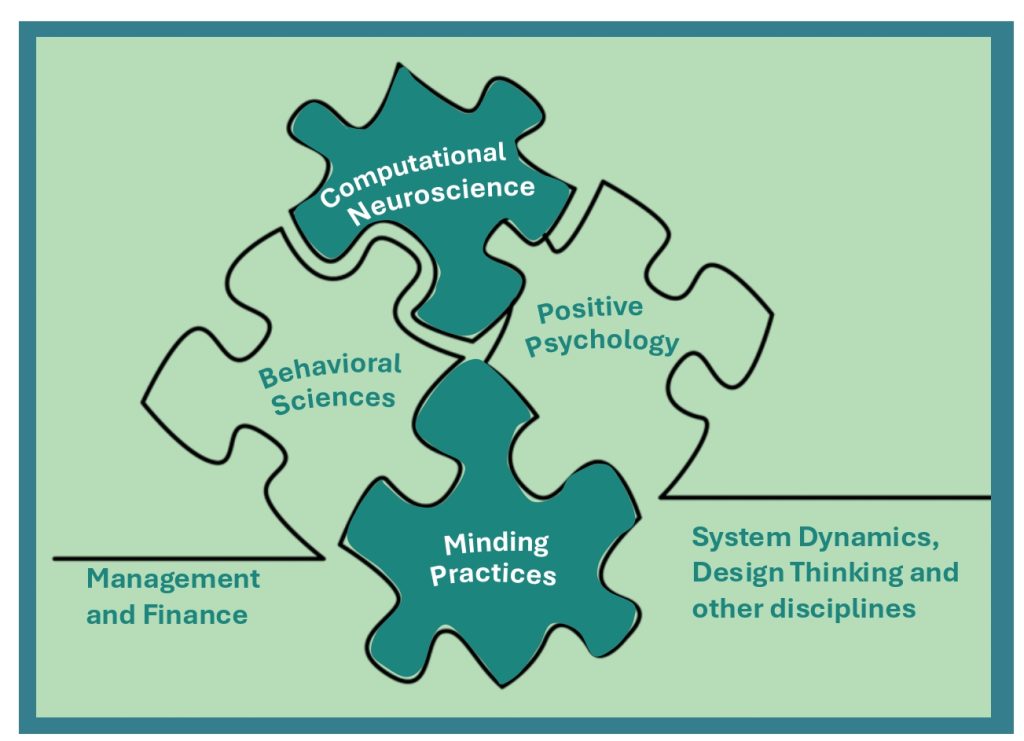
MBSAT Scientific Foundations
At the core of MBSAT lies a robust scientific framework grounded in computational neuroscience. This approach views the brain as a tireless prediction machine. We constantly make predictions about the world around us, and when those predictions are off the mark, we experience a ‘surprise’ or prediction error. MBSAT leverages this principle.
Imagine your brain as a sophisticated composite of internal models, continuously refined based on your ongoing experiences. MBSAT, inspired by the Free Energy Minimizing Principle, teaches you to understand your personal internal models. By recognizing how your brain makes predictions and adjusts them based on what you experience, you gain a powerful tool for self-awareness.
In essence, MBSAT liberates the profound, practical potential of the Free Energy Principle, translating complex scientific theories into practical strategies for everyday life. It’s about harnessing the brain’s natural ability for self-organization to navigate the complexities of the 21st century with greater mindfulness, skill, and a sense of thriving.
Base glossary of computational neuroscience terms use in MBSAT protocol
Free Energy Principle:
Prediction:
Prediction Error:
Sometimes, those predictions are off the mark. This mismatch between what you expect and what happens is called a prediction error. These errors can be helpful because they signal the need to update your brain’s models of the world.
Recognition Models:
This is your brain’s understanding of how the world works. It’s like an internal map that helps you make sense of things. For example, your recognition models tell you the shape and feel of an apple.
Generative Models:
These models allow your brain to imagine and predict not just what is but what could be. It drives creativity and planning. For example, your generative models help you picture the perfect way to arrange your living room, even before you move the furniture.
Active Inference:
This concept isn’t just about passively taking in information. Active inference is how your brain actively shapes the world by taking actions to test its predictions. For example, if you predict there’s a book on the table, active inference drives you to reach out and confirm (or, if not, to correct) that prediction.
Minding: A foundation for individual and collective flourishing
Precision:
Opacity:
Imagine looking out a perfectly clear window. The glass is so transparent you barely notice it’s there. This transparency can be problematic because you’re so focused on the view beyond that you miss the window glass itself. In Metzinger’s view, this is similar to opacity. When our beliefs, habits, and internal processes become completely familiar, they are like a transparent, invisible glass pane and operate unconsciously, influencing our behavior without our awareness.
The concept of opacity from a computational neuroscience perspective was developed by the German cognitive philosopher Thomas Metzinger. Through MBSAT practices and introspection we can bring our up to now transparent beliefs and biases into focus, allowing us to “see the smudge on the window” and make informed choices about how we want to live.